
Almost everything that goes wrong with a house in January was already going wrong in October. The difference is that in October it is a twenty minute job, and in January it is an emergency call-out in the dark and the rain.
This is what is worth checking now, while the weather still lets you.
Drains and gutters come first
Autumn is the worst time of year for drainage, and it is not complicated why: the leaves come down, the rain arrives, and the two meet in your gutters and gullies. Silt that built up quietly over summer gets a proper test the first time it rains hard for a few hours, which is why gutter cleaning is worth doing before the weather turns rather than after.
What that looks like when it fails:
- Water pouring over the edge of a gutter instead of down the downpipe
- An outside gully that fills up and drains away slowly, or not at all
- Damp patches appearing on an internal wall below a gutter joint
- A drain that gurgles, or a toilet that empties more slowly than it did
- Standing water where there did not used to be any
Gurgling and slow draining are worth taking seriously, because they usually mean a partial blockage rather than a clear run. Partial blockages do not stay partial. They collect whatever comes past them until the day they stop everything, and that day is almost always the day it rains hardest.
Most of this is straightforward to clear if you get to it early — see blocked drain clearance. Where a drain keeps blocking after being cleared, that is a sign of something structural rather than something stuck: a collapsed section, a displaced joint, or roots that have found their way in. A CCTV drain survey shows you which of those it is before anyone digs anything up, which is usually the difference between a repair and a rebuild.
Outside taps and exposed pipework
The first hard frost of the year does more plumbing damage than the rest of the winter put together, because it catches everything that was never protected. Water expands as it freezes, and a pipe that splits while frozen will not usually show it until the thaw — at which point it leaks in a wall or under a floor rather than somewhere obvious.
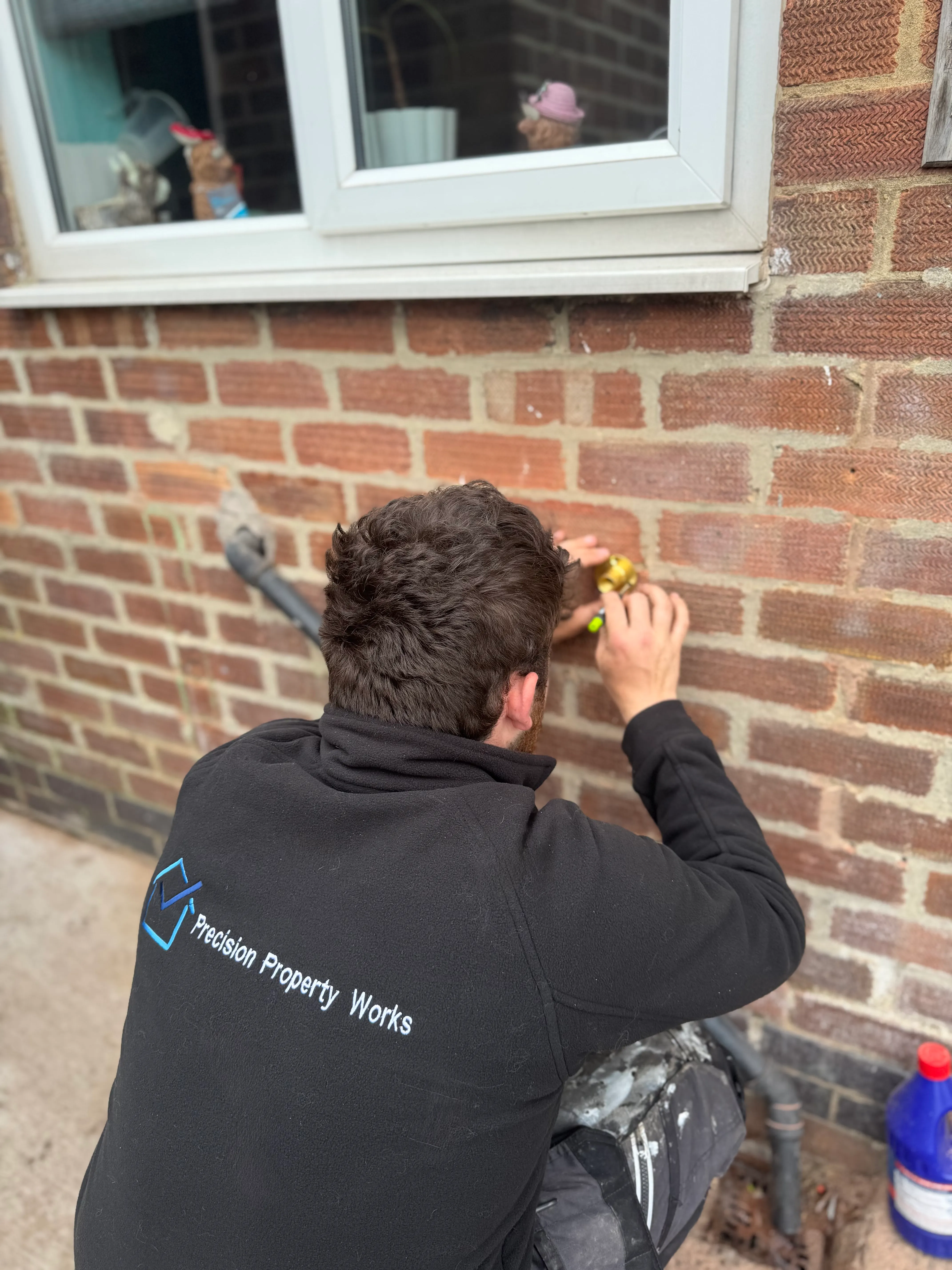
Before the temperature drops, it is worth turning off and draining down any outside tap, lagging exposed pipework in lofts, garages and outbuildings, and checking that any pipe insulation already up there has not perished or fallen away. If you have a stopcock you have never tested, find it and check it turns — the middle of a leak is a bad time to discover it is seized. Plumbing repairs and installations of this sort are quick, planned jobs in September and emergencies in January.
The roof and everything at the edge of it
Autumn storms find whatever winter damage was left over from last year. Loose tiles, slipped flashing around a chimney, failed pointing, a fascia board that has started to go soft — none of these are urgent in still weather, and all of them are urgent in a gale.
Most of it can be assessed from the ground with a decent pair of eyes. Look for tiles that sit differently from their neighbours, mortar that has cracked or dropped out, staining on brickwork below a gutter joint, and any timber that looks darker than it should.
Knowing about a slipped tile in September and knowing about it in December are two very different jobs, and only one of them happens in the dry.
Inside, once the heating goes on
Condensation problems appear within a fortnight of the heating being switched on, and they get misread as damp coming in from outside more often than not. Warm, moist air meets a cold surface and settles on it, usually in the corners of north-facing rooms, behind furniture on external walls, and around window reveals.
Damp from a leak and damp from condensation want opposite treatments, so it is worth knowing which you have before you start buying things. Condensation is a ventilation and heating pattern problem. A leak is a leak, and painting over it achieves nothing except hiding it until spring.
What to check this month
Outside:
- Gutters, downpipes and gullies, cleared of the summer's silt
- Outside taps isolated and drained
- Roof tiles, flashing and pointing, looked at from the ground
- Drainage away from the walls, with no water pooling near the foundations
- Fences and gates, before the first real wind rather than after
Inside:
- Heating run up to temperature once, early, so a fault surfaces now
- Loft insulation and any exposed pipework up there
- Extractor fans in the bathroom and kitchen actually extracting
- Window and door seals, and anything that has started to stick
When to get someone out
If a drain has blocked more than once in the same year, if damp keeps returning in the same patch after being treated, or if you can see water getting in anywhere at all, that is not a wait-and-see situation. Those three all get worse on a schedule set by the weather rather than by you.
How Precision Property Works can help
We cover Leicestershire and Derbyshire for drainage, plumbing, roofing repairs and general property maintenance, and autumn is when most of it is worth doing. If you would rather have one visit that deals with the lot than four separate call-outs over the winter, that is the sensible way round.
If something has already started — a slow drain, a damp patch, a gutter running over — send us a photo on WhatsApp and we can usually tell you whether it needs us or not.
Need a hand with your property?
We cover Leicestershire and Derbyshire for maintenance, renovation and drainage work.